Informational Note
This article is for educational purposes and does not replace the surgeon’s instructions or an individual physiotherapy assessment. Timelines and exercises may vary according to graft type, associated injuries, the surgical procedure, and each patient’s progress.
An anterior cruciate ligament injury can change how a person walks, trains, or practices their favorite sport in a matter of seconds. After surgery, it is common to feel relief at having completed the procedure, but also uncertainty: When will I be able to walk normally? When can I run again? Will my knee be the same as before?
Surgery reconstructs the ligament, but it does not automatically restore knee mobility, strength, or control. These components develop through a progressive rehabilitation process that must consider tissue healing, the joint’s response, muscle strength, movement quality, and each patient’s goals. Current guidelines consider therapeutic exercise the main component of rehabilitation after anterior cruciate ligament reconstruction.
Recovery is not simply a matter of waiting a certain number of weeks or months. Progression should be based on clinical evolution and objective criteria indicating whether the knee is ready to advance toward more demanding loads.
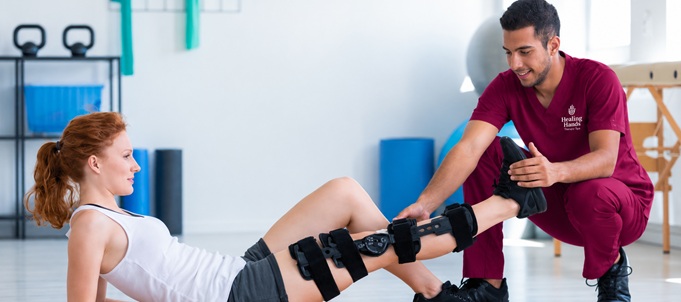
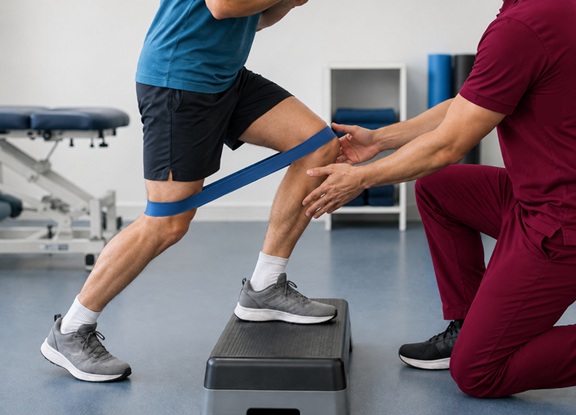
Patient performing an exercise to activate the quadriceps after ACL reconstruction
What Is the Anterior Cruciate Ligament and What Is Its Function?
The anterior cruciate ligament, known as the ACL, is located inside the knee and connects the femur to the tibia. Its functions include limiting excessive forward movement of the tibia and helping control rotational movements of the knee.
This ligament is especially important during activities requiring changes of direction, deceleration, jumping, landing, or pivoting. For this reason, ACL injuries are common in sports such as soccer, basketball, volleyball, handball, and disciplines involving rapid movements on one leg.
When the ACL is injured, some people experience pain, swelling, and difficulty moving the knee. Others report instability or a feeling that the knee “gives way,” especially when turning or changing direction.
What Does ACL Reconstruction Surgery Involve?
In most reconstructions, the injured ligament is not sutured directly. The surgeon uses a graft to create a new ligament. This graft may be taken from the patient, for example from the hamstring tendons, patellar tendon, or quadriceps tendon. Other graft types may also be used in certain situations.
After placement, the graft must gradually integrate into the knee and undergo a biological adaptation process. Even if the person feels less pain and walks better during the early stages, this does not mean the tissue is fully prepared for running, jumping, or changing direction.
The protocol may also change if a meniscus repair, cartilage procedure, or another associated intervention was performed during surgery. In these cases, specific precautions may apply to weight bearing, mobility, or loading. Communication among the surgeon, physiotherapist, and patient is therefore essential.
Rehabilitation Begins Before Surgery
When conditions allow, physiotherapy can begin before the operation. This stage is known as preoperative rehabilitation or prehabilitation.
The goals may include:
- Reducing swelling.
- Restoring full knee extension.
- Progressively improving flexion.
- Reactivating the quadriceps.
- Normalizing gait.
- Preparing the patient for the postoperative process.
- Explaining the expectations and stages of rehabilitation.
The Aspetar clinical guideline indicates that preoperative rehabilitation may improve postoperative quadriceps strength and knee range of motion. It also recommends that the patient reach surgery with adequate voluntary muscle activation and without a significant extension limitation, whenever the clinical condition allows.
Why Is Physiotherapy So Important After Surgery?
After ACL reconstruction, the knee may present pain, swelling, restricted movement, and difficulty activating the quadriceps. Changes in gait, loss of strength, reduced balance, and fear of movement may also appear.
Physiotherapy helps progressively restore these capacities. Treatment is not limited to strengthening the knee: it should also address the hips, trunk, ankle, coordination, cardiovascular capacity, and the specific movements the person needs in order to return to their activities.
Physical modalities may be used as an adjunct during the early phase to help manage pain, swelling, or mobility limitations. However, they do not replace therapeutic exercise, which remains the foundation of recovery.
Rehabilitation Should Not Progress Based on Time Alone
Two patients operated on the same day may progress differently. One may quickly regain extension and quadriceps activation, while another may experience more swelling, pain, or difficulty walking.
For this reason, the stages presented below are only a guide. Progression should depend on factors such as:
- Condition of the surgical wound.
- Pain and swelling.
- Knee range of motion.
- Ability to activate the quadriceps.
- Quality of gait.
- Strength of the operated limb.
- Control during functional tasks.
- Graft type and associated procedures.
- The surgeon’s instructions.
- Work, recreational, or sports goals.
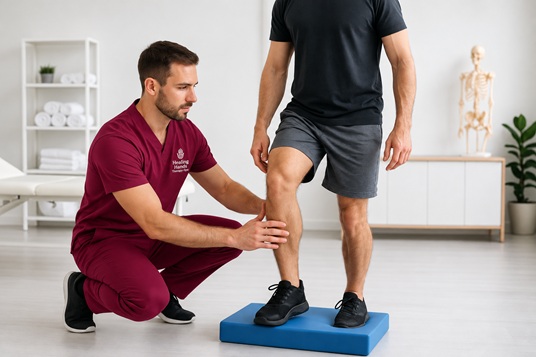
Balance exercise during postoperative knee rehabilitation
Modern protocols combine biological healing time with clinical indicators and functional testing. This helps prevent progression that is too rapid, while also reducing unnecessary restrictions when the patient already meets the criteria to advance.
Stages of Rehabilitation After ACL Surgery
Stage One: Protect the Knee and Restore Basic Function
During the first days and weeks, the main goals are usually to control pain and swelling, restore knee extension, gradually improve flexion, and activate the quadriceps.
The patient also works on walking according to the weight-bearing instructions established by the surgical team. Some people use crutches or a knee brace during this phase, depending on the procedure and medical recommendations.
Treatment may include:
- Education about safe positions and movements.
- Strategies to control swelling.
- Progressive knee mobility.
- Quadriceps activation.
- Exercises for the hip and ankle.
- Gait training.
- Circulatory exercises.
- Guidance on the use of crutches.
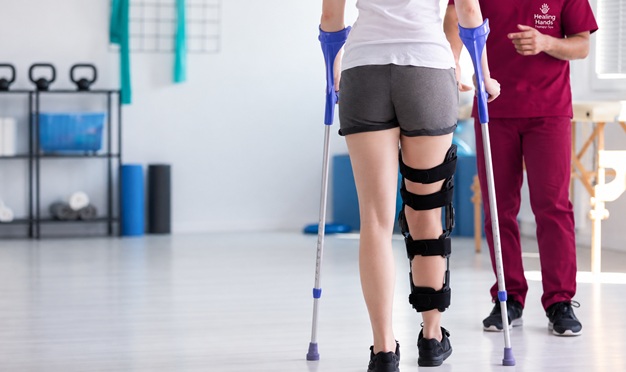
Guidance on the correct use of crutches.
Restoring full extension is an important priority. A persistent limitation can alter gait, make quadriceps activation more difficult, and affect later stages of rehabilitation.
Common Signs That the Patient Is Ready to Progress
Progression may be considered when the wound is healing well, swelling has decreased, muscular control has improved, extension is adequate, and the patient can walk more safely. Exact criteria must be adapted to the surgical instructions and the individual response.
Stage Two: Restore Mobility, Gait, and Initial Strength
Once the knee tolerates basic activities better, the program focuses on restoring mobility, normalizing gait, and progressively building strength.
Exercises introduced during this phase may include:
- Squats within a controlled range.
- Bridges.
- Heel raises.
- Hip strengthening.
- Balance exercises.
- Stationary cycling, when mobility permits.
- Knee extension and flexion exercises with an appropriate load.
- Low step-ups.
- Progressive single-leg stability work.
Open and closed kinetic chain exercises may be part of rehabilitation when appropriately prescribed. Contemporary evidence supports the progressive inclusion of specific quadriceps strengthening, avoiding unnecessary delay and adjusting the range, load, and response of the knee.
Stage Three: Develop Limb Strength and Control
As mobility improves, greater emphasis is placed on strengthening the quadriceps, hamstrings, glutes, calf, and trunk.
Quadriceps strength loss is one of the most important challenges after ACL reconstruction. It is not enough for both legs to appear similar. Strength should be measured and the capacity to produce force during functional tasks should be assessed.
This stage may include:
- Progressive squats.
- Leg press.
- Lunges.
- Deadlifts and adapted variations.
- Step-ups and step-downs.
- Resisted knee extension.
- Single-leg exercises.
- Balance and postural control training.
- Cardiovascular work without impact or with controlled impact.
Volume, intensity, and difficulty should increase gradually. After each progression, the knee’s response is monitored: pain, swelling, loss of motion, or gait changes may indicate that the load needs adjustment.
Stage Four: Preparing to Run
Returning to running is an important goal, but it should not be decided only because a certain number of weeks have passed.
Before starting a running program, the physiotherapist may assess:
- No swelling or only minimal swelling.
- Adequate mobility.
- Normal gait.
- Tolerance to strengthening exercises.
- Ability to perform single-leg tasks.
- Sufficient quadriceps strength.
- Control during small jumps or preparatory activities.
- Absence of significant pain during and after training.
The Aspetar guideline identifies return to running as a key milestone and proposes assessing clinical, strength, and performance criteria before introducing it. However, it also recognizes variability in the criteria used and states that the decision should be individualized.
Returning to running may begin with intervals alternating walking and jogging. Distance, speed, and duration increase gradually, while monitoring how the knee responds during the following hours and the next day.
Stage Five: Power, Jumping, and Changes of Direction
Running in a straight line does not mean the knee is ready for sport. Activities such as jumping, landing, stopping, or changing direction require higher levels of strength, speed, and control.
This phase may include:
- Two-leg jumps.
- Single-leg jumps.
- Landing training.
- Deceleration exercises.
- Higher-speed running.
- Progressive changes of direction.
- Agility tasks.
- Reactive exercises.
- Sport- or activity-specific work.
Movement quality is as important as the number of repetitions. The patient must learn to control the position of the trunk, pelvis, hip, and knee during fast movements and under fatigue.
Stage Six: Return to Training and Sport
Returning to sport is not a single moment. It can be divided into several levels:
- Return to participation: the person begins modified sports tasks.
- Return to sport: the person returns to training and competition, although restrictions may still be present.
- Return to performance: the person regains a level of performance similar to or better than before the injury.
Before clearing a return to sports involving pivoting, contact, or changes of direction, information about strength, hop tests, movement quality, load tolerance, psychological readiness, and sport-specific demands should be combined. No single test can confirm that injury risk has disappeared.
How Long Does Rehabilitation Take?
There is no identical duration for everyone. The process depends on graft type, associated injuries, the knee’s response, previous activity level, sports goals, and adherence to the program.
Daily activities and controlled exercises may be recovered before sports involving jumping and changes of direction. A full return to sport usually requires a prolonged process because the absence of pain does not guarantee that strength, control, or psychological readiness has been restored.
One cohort study found a progressive reduction in the risk of reinjury for each month that return to high-demand sport was delayed up to nine months, and observed better outcomes among those who met functional criteria. More recent research also emphasizes that time alone is not sufficient: completing rehabilitation and meeting objective criteria are essential for decision-making.
Therefore, nine months should not be interpreted as automatic clearance. Some patients will need more time, while others may reach certain goals earlier. The final decision should integrate biological healing time, functional tests, and physical and emotional readiness.
The Importance of Restoring Quadriceps Strength
After surgery, the quadriceps can lose strength quickly and may be difficult to activate. This muscular inhibition can persist even after pain has decreased.
A weak quadriceps can affect:
- Gait.
- The ability to go up and down stairs.
- Control during landing.
- Load absorption.
- Running.
- Changes of direction.
- Confidence in the operated leg.
Rehabilitation guidelines recommend frequent strength measurement and using the results to guide progression. Symmetry between legs is useful, but absolute strength should also be considered because the non-operated leg may have lost capacity during the period of inactivity.
Psychological Recovery Is Also Part of Treatment
A person may regain strength and mobility but still feel afraid to jump, pivot, or return to competition. Fear of reinjury is a common barrier to returning to sport.
Rehabilitation should include gradual exposure to activities that create insecurity. Beginning with simple tasks, progressing toward specific movements, and practicing in controlled situations helps rebuild confidence.
Communication among the patient, physiotherapist, coach, and surgeon also helps establish realistic expectations. Studies of return to sport identify fear of reinjury and persistent knee problems among the main reasons for not returning to the previous level.
Common Mistakes During Rehabilitation
- Comparing recovery with another patient’s recovery.
- Progressing only because a certain number of weeks have passed.
- Ignoring swelling after exercise.
- Avoiding quadriceps strengthening for too long.
- Performing exercises without controlling technique.
- Returning to running without sufficient strength and control.
- Confusing absence of pain with complete recovery.
- Performing jumps or changes of direction before being ready.
- Stopping physiotherapy once walking has recovered.
- Returning to sport without functional testing.
- Training only the operated leg.
- Not continuing a prevention program after returning to sport.
Warning Signs That Require Prompt Assessment
Mild pain or swelling may occur during recovery, especially after increasing the load. However, it is important to contact the medical team if any of the following occur:
- Fever.
- Increasing redness around the wound.
- Discharge or a foul smell from the incision.
- Severe pain that is getting worse.
- Sudden calf swelling.
- Difficulty breathing.
- Sudden loss of mobility.
- A locking sensation in the knee.
- A new episode of instability or trauma.
- Persistent swelling that does not improve after load adjustments.
These signs do not confirm a complication by themselves, but they require timely assessment.
Rehabilitation After ACL Surgery at Healing Hands
At Healing Hands, Antigua Guatemala, we approach anterior cruciate ligament rehabilitation through an individualized and progressive program.
Our approach may include:
- Assessment of pain, swelling, and mobility.
- Restoration of knee extension and flexion.
- Quadriceps activation and strengthening.
- Gait retraining.
- Strengthening of the hip, knee, calf, and trunk.
- Balance and neuromuscular control exercises.
- Progressive preparation for running.
- Jump and landing training.
- Speed, agility, and change-of-direction work.
- Strength and functional testing.
- Gradual return to exercise, work, or sport.
- A prevention program to reduce the risk of reinjury.
Physiotherapist guiding a progressive return to sport at Healing Hands, Antigua Guatemala
The goal is not only to make the knee move. We seek to help the patient regain strength, control, confidence, and the ability to return to the activities that are important in their life.
How to Schedule an Assessment?
If you are recovering after anterior cruciate ligament surgery, a physiotherapy assessment can identify your current stage and the capacities you still need to develop.
You can schedule an appointment at Healing Hands, Antigua Guatemala, through our website or by contacting our team directly through WhatsApp.
Every rehabilitation process is different. A personalized program can help you progress safely, measurably, and according to your goals.
Bibliographic References in APA Format
Aguero, A. D., Dietrich, J. W., Colgan, K., Said, J. Z., Fitzgerald, G. K., VonVille, H. M., & Irrgang, J. J. (2024). Factors associated with return to sport and reinjury in athletes after anterior cruciate ligament reconstruction: A systematic review with meta-analysis. JOSPT Open, 2(1), 8–19. https://doi.org/10.2519/josptopen.2023.0503
Brinlee, A. W., Dickenson, S. B., Hunter-Giordano, A., & Snyder-Mackler, L. (2022). ACL reconstruction rehabilitation: Clinical data, biologic healing, and criterion-based milestones to inform a return-to-sport guideline. Sports Health, 14(5), 770–779. https://doi.org/10.1177/19417381211056873
Grindem, H., Snyder-Mackler, L., Moksnes, H., Engebretsen, L., & Risberg, M. A. (2016). Simple decision rules can reduce reinjury risk by 84% after ACL reconstruction: The Delaware-Oslo ACL cohort study. British Journal of Sports Medicine, 50(13), 804–808. https://doi.org/10.1136/bjsports-2016-096031
Kotsifaki, R., Korakakis, V., King, E., Barbosa, O., Maree, D., Pantouveris, M., Bjerregaard, A., Luomajoki, J., Wilhelmsen, J., & Whiteley, R. (2023). Aspetar clinical practice guideline on rehabilitation after anterior cruciate ligament reconstruction. British Journal of Sports Medicine, 57(9), 500–514. https://doi.org/10.1136/bjsports-2022-106158
Kooy, C., Bache-Mathiesen, L., Jakobsen, R. B., Engebretsen, L., Persson, A., Myklebust, G., & Grindem, H. (2025). Rehabilitation, decision making, and return to pivoting sports in athletes 1–3 years after ACL reconstruction: A nationwide study. JOSPT Open, 3(1), 45–58. https://doi.org/10.2519/josptopen.2024.0087