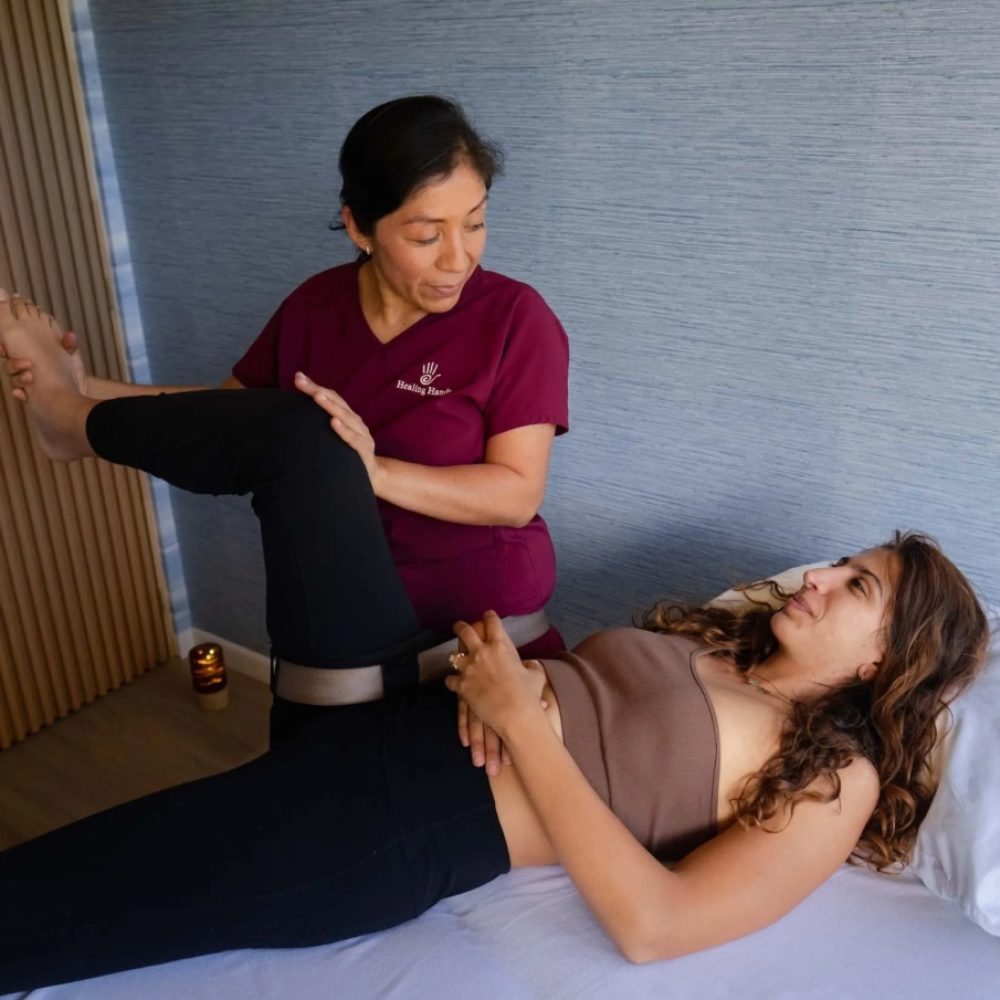
Running can be one of the simplest and most freeing ways to move: all you need are your shoes, your body, and the road. But when a sharp pain appears on the outside of the knee, especially after running a certain distance, that feeling of freedom can turn into frustration. This pain may be related to iliotibial band syndrome, also known as runner’s knee, one of the most common causes of lateral knee pain in runners.
Iliotibial band syndrome does not affect runners only. It can also appear in cyclists, hikers, people who practice sports involving repetitive knee movements, or those who have suddenly increased their training load. However, it is especially common in runners because of the repeated flexion and extension of the knee during each stride.
What is the iliotibial band?
The iliotibial band is a strong connective tissue structure that runs along the outside of the thigh. It extends from the pelvis, passing through the hip and the outer side of the leg, until it inserts near the knee, on the tibia. This band helps stabilize the hip and knee during activities such as walking, running, climbing slopes, going up stairs, or standing on one leg.
For many years, the main problem was believed to be “friction” of the iliotibial band against the lateral bone of the femur. However, more recent research suggests that the pain may be more related to compression of sensitive, highly innervated tissues beneath the iliotibial band, especially when the knee repeatedly flexes near 30 degrees.
In simple terms: it is not only about “a band rubbing against the bone,” but rather a mechanical overload that may involve the hip, knee, running technique, muscle strength, and the way the body distributes loads during movement. This syndrome can also commonly appear after arthroplasty or total knee replacement during gait retraining or in the final phases when training stair climbing and descending.
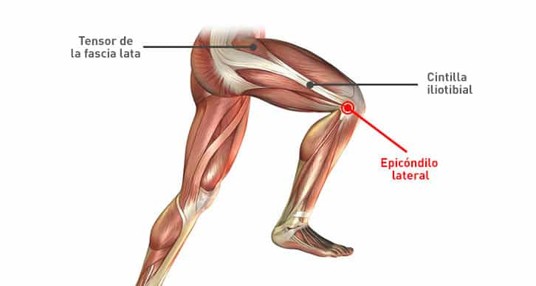
Anatomy of the Iliotibial Band and Tensor Fasciae Latae Muscle
Why does runner’s knee appear?
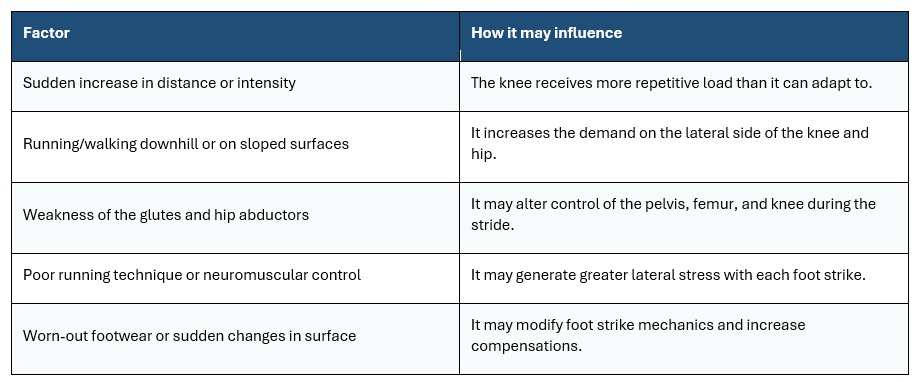
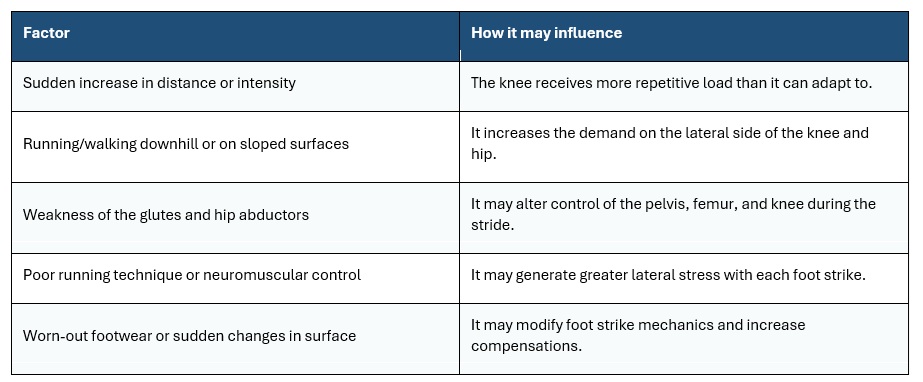
Iliotibial band syndrome is usually considered an overuse injury. This means it appears when tissues receive more load than they can tolerate or recover from. In runners, it may be associated with sudden mileage changes, downhill training, sloped surfaces, running technique, weakness of the hip muscles, or alterations in neuromuscular control.
Current evidence indicates that there is no single cause. In reality, it is a multifactorial problem. Some studies suggest that weakness of the hip abductors, altered leg control during running, and sudden changes in training intensity or volume may influence the development of this condition.
This explains why many people feel temporary relief with rest or massage, but the pain returns when they start running again. If the factors that increase load on the knee are not corrected, the symptom may reappear at the same point in training, for example, always at kilometer 3 or after running downhill.
Common associated factors
Most common symptoms of iliotibial band syndrome
The main symptom is pain on the outside of the knee. Many people describe it as sharp discomfort, burning, pressure, or a lateral “pulling” sensation. It usually appears during running, especially after a certain time or distance, and improves when the activity stops.
Pain may also appear when running downhill, going down stairs, cycling, or spending a long time with the knee flexed. In some cases, the discomfort may radiate toward the outer thigh or hip, although the most characteristic point is located near the outside of the knee.
It is important to differentiate it from other causes of lateral knee pain, such as meniscal injuries, ligament problems, joint disorders, or referred pain from the hip or spine. That is why an appropriate physiotherapy evaluation is key to identifying the true origin of the problem.
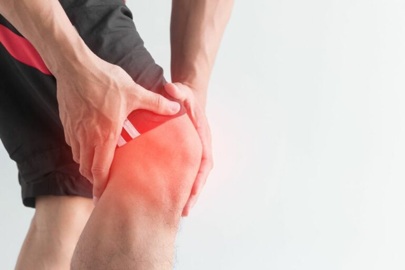
Runner with outer knee pain due to iliotibial band syndrome
How is it evaluated in physiotherapy?
At Healing Hands, the evaluation does not focus only on the knee. Although the pain appears there, the origin of the problem may often be related to the hip, foot, running technique, trunk control, or the way the body absorbs impact. Current approaches recommend assessing the biomechanics and overall function of the lower limb.
During the evaluation, aspects such as glute strength, hip mobility, single-leg squat control, pelvic stability, running pattern, load tolerance, and pain when pressing specific areas of the lateral knee may be analyzed. Some clinical tests, such as Noble or Ober, can help guide the diagnosis, although they are not definitive on their own.
The goal is not only to give the pain a name, but to understand why it appeared and what your body needs in order to return to running, walking, or training with confidence.
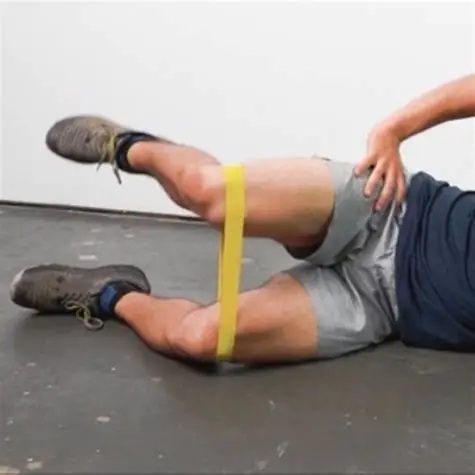
Hip strengthening exercise to prevent runner’s knee
Evidence-based treatment
Treatment for iliotibial band syndrome is usually conservative, meaning non-surgical. Initial recommendations include temporarily modifying activities that trigger pain, reducing or adjusting training load, avoiding downhill or sloped surfaces, and progressively working on mobility, strength, and neuromuscular control.
A systematic review published in 2024 found that conservative programs can improve pain and function in runners with iliotibial band syndrome. Among the most common strategies are hip abductor strengthening, manual therapy, patient education, and, in some cases, gait or running retraining.
Hip strengthening is especially important because the glutes help control the position of the pelvis, femur, and knee during running. When these muscles do not work efficiently, the knee may receive more lateral load with each step. Manual therapy can also be useful to improve tissue mobility, reduce pain, address myofascial restrictions, and help the patient move better. However, the most effective approach is usually multifactorial: it is not enough to simply “release the band”; movement must also be retrained and the structures that control load must be strengthened.
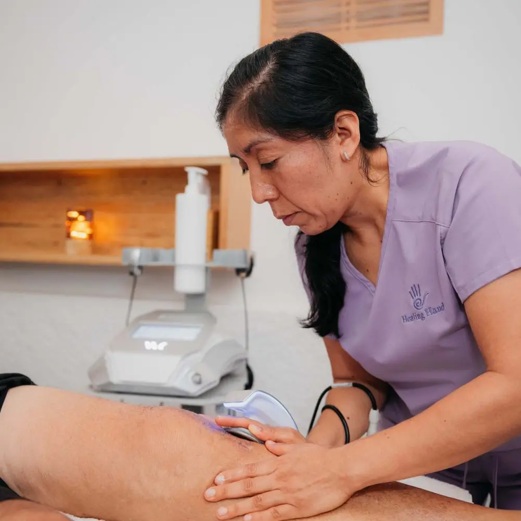
Manual therapy combined with tecar therapy for iliotibial band syndrome in a physiotherapy clinic.
Should you stop running completely?
Not always. The answer depends on the intensity of the pain, the stage of the injury, and the patient’s goals. In some cases, a temporary pause from pain-provoking activities is recommended; in others, modified physical activity can be maintained as long as symptoms do not increase.
A good return-to-running strategy should be gradual. This may include pain-free walking, light jogging, short intervals, reduced mileage, avoiding downhill running, and progressing according to the body’s response. The key is not to run “despite the pain,” but to return to running with a stronger, more stable, and more efficient foundation.
Iliotibial band syndrome at Healing Hands
At Healing Hands, Antigua Guatemala, we approach runner’s knee from an integral perspective. We evaluate the knee, but also the hip, foot, postural control, muscle strength, mobility, and training habits.
Our approach may include:
- Personalized physiotherapy evaluation.
- Manual therapy and myofascial release.
- Strengthening of the glutes, hip, and stabilizing muscles.
- Neuromuscular control exercises.
- Functional re-education and progressive return to running.
- Education on load, recovery, and relapse prevention.
This type of approach aligns with current evidence, which recommends treating iliotibial band syndrome as a multifactorial condition and not only as a localized knee problem.
Who can benefit from this treatment?
This treatment may be useful for runners who feel outer knee pain, athletes who experience discomfort while running, cyclists with lateral knee pain, people who have recently increased their training load, or patients who have tried rest and massage but feel the pain return when they resume activity.
It may also benefit people who want to prevent injuries before a race, improve their movement technique, or return to exercise after a period of inactivity.
How to schedule a session?
If pain on the outside of your knee appears every time you run, do not ignore it. The body often warns you before it stops you completely.
You can schedule an evaluation at Healing Hands, Antigua Guatemala, through our website or by contacting us directly through WhatsApp. Our team is ready to support you with professional, personalized, evidence-based treatment.
Bibliographic references in APA format
Bonoan, M., Morales, M., Liu, X. W., Oyeniran, O., Zheng, K., & Palatulan, E. (2024). Iliotibial band syndrome current evidence. Current Reviews in Musculoskeletal Medicine. https://doi.org/10.1007/s40141-024-00442-w
Pegrum, J., Self, A., & Hall, N. (2019). Iliotibial band syndrome. BMJ, 364, l980. https://doi.org/10.1136/bmj.l980
Sanchez-Alvarado, A., Bokil, C., Cassel, M., & Engel, T. (2024). Effects of conservative treatment strategies for iliotibial band syndrome on pain and function in runners: A systematic review. Frontiers in Sports and Active Living, 6, 1386456. https://doi.org/10.3389/fspor.2024.1386456
Shamus, J., & Shamus, E. (2015). The management of iliotibial band syndrome with a multifaceted approach: A double case report. International Journal of Sports Physical Therapy, 10(3), 378–390.